Engine Configuration: The Heart of the Hypercar
The engine is the heart of a hypercar, and its configuration fundamentally shapes the car’s character, sound and performance. Let’s explore the different engine types you’ll find in the Cars 2026 deck.
Traditional Combustion Layouts
Different cylinder arrangements offer distinct advantages:
V8 Engines
The most common hypercar engine layout:
- Eight cylinders in a V configuration
- Compact and relatively lightweight
- Excellent power-to-weight ratio
- Often turbocharged to extract 700-800+ HP
- Found in: McLaren 720S, Ferrari F8 Tributo, Corvette Z06
Character: Responsive, high-revving, modern V8s deliver explosive power with relatively low weight.
V10 Engines
Less common but distinctive:
- Ten cylinders in a V layout
- Larger and heavier than V8
- Glorious sound — often considered the best-sounding configuration
- Often naturally aspirated in supercars
- Found in: Lamborghini Huracán, Audi R8
Character: Exotic, emotional, sonorous. The V10 delivers drama alongside performance.
V12 Engines
The traditional hypercar engine:
- Twelve cylinders in a V configuration
- Smooth, refined power delivery
- Magnificent sound
- Heavy and complex
- Found in: Ferrari 812 Superfast, Lamborghini Aventador, Aston Martin Valkyrie
Character: Aristocratic, smooth, endlessly powerful. The V12 is about effortless performance and prestige.
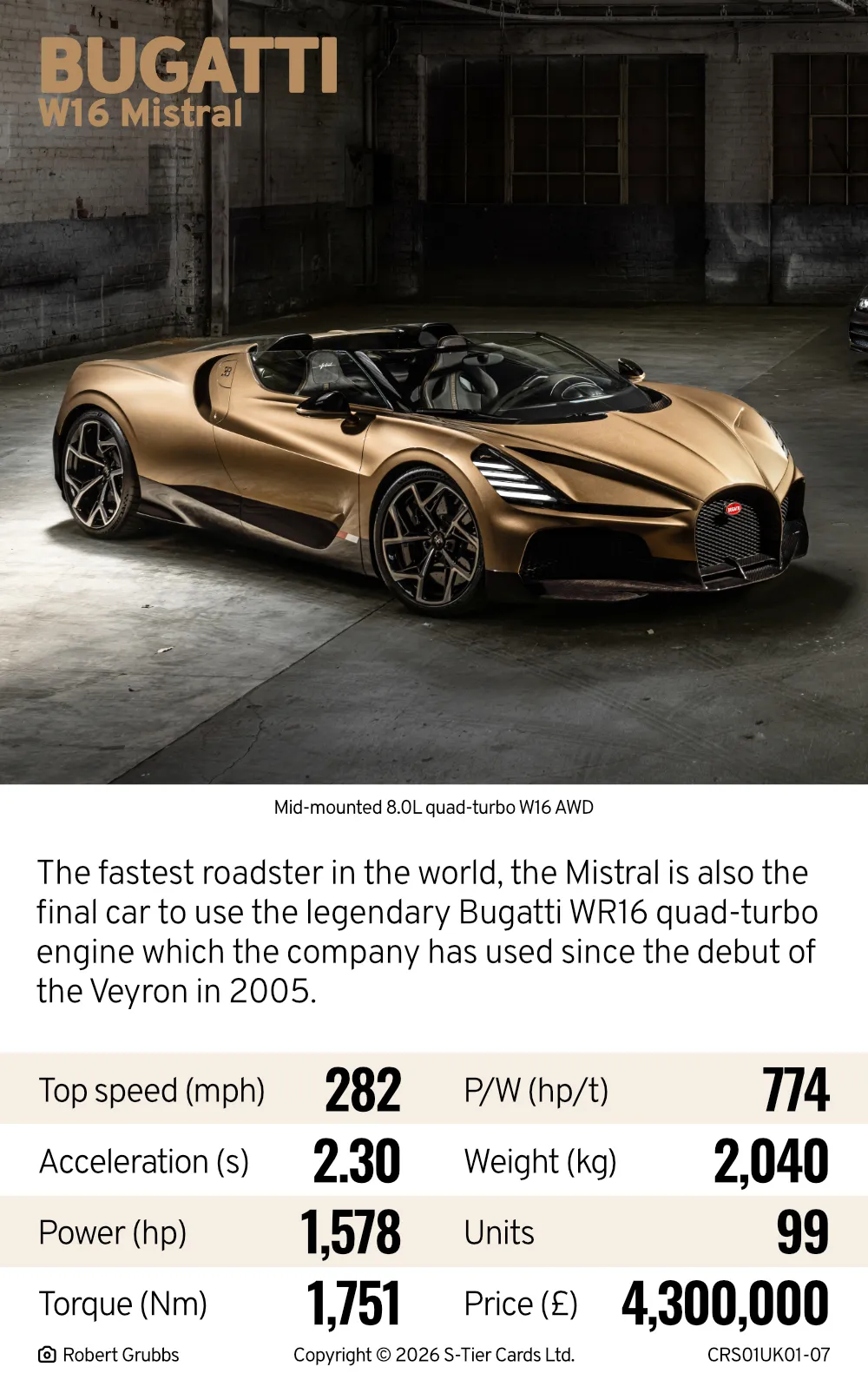
W16 Engines
Bugatti’s unique creation:
- Essentially two V8 engines on a common crankshaft
- Sixteen cylinders, four turbochargers
- Massive power (1,500+ HP) and torque
- Extremely complex and heavy
- Found exclusively in: Bugatti Veyron, Chiron, Mistral
Character: Brutally powerful, refined despite the power, unique in the automotive world.
Flat/Boxer Engines
Horizontally opposed cylinders:
- Low centre of gravity
- Excellent weight distribution
- Distinctive sound
- Found in: Porsche 911, Porsche 718
Character: Balanced, responsive, characterful sound. The layout that defined Porsche.
Forced Induction
How air is forced into the engine dramatically affects power delivery:
Turbocharged
Uses exhaust gases to spin a turbine that compresses intake air:
- Dramatic power increase
- Modern turbos have minimal lag
- Allows smaller displacement with big power
- Can produce flat torque curves
Trade-offs: Historically had throttle lag; modern systems have largely solved this but add complexity.
Supercharged
Belt-driven compressor (no exhaust gases involved):
- Instant response, no lag
- Linear power delivery
- Adds parasitic load to the engine
- Slightly less efficient than turbocharging
Trade-offs: Uses engine power to drive the compressor; less common in modern hypercars.
Naturally Aspirated
No forced induction — power comes from displacement and RPM:
- Linear, predictable power delivery
- Instant throttle response
- Glorious high-RPM sound
- Less powerful per litre than forced induction
- Increasingly rare due to emissions regulations
Trade-offs: Lower power density; larger engines needed to match turbocharged outputs.
Hybrid Powertrains
Combining combustion engines with electric motors:
How They Work
- Electric motors supplement the combustion engine
- Can provide instant torque at low RPM
- Batteries can be charged by the engine or regenerative braking
- Some offer pure electric driving for short distances
Advantages
- Stratospheric power outputs (often 900+ HP combined)
- Instant electric torque fills in turbo lag
- Improved efficiency (in theory)
- Marketing appeal: performance plus “electrification”
Trade-Offs
- Significant weight penalty (batteries, motors, wiring)
- Complexity: two powertrains to maintain
- Battery degradation over time
- Often more expensive
Found In
- Ferrari SF90 Stradale
- McLaren Artura
- Lamborghini Revuelto
- Porsche 918 Spyder (now discontinued)
Pure Electric
The future, already here:
How They Work
- Multiple electric motors (often one per wheel)
- Large battery pack (often 90-120 kWh)
- Instant maximum torque from 0 RPM
- Software-controlled power delivery
Advantages
- Devastating acceleration (often sub-2-second 0-60)
- All-wheel drive with individual wheel control
- Silent operation
- Lower maintenance (no engine servicing)
Trade-Offs
- Heavy (battery packs weigh 600+ kg)
- Limited range at high speed (battery drain is extreme at 200+ mph)
- Long recharge times (relative to refuelling)
- Lacking the sound and emotion of combustion
Found In
- Rimac Nevera
- Lotus Evija
- Pininfarina Battista
- Aspark Owl
Engine Placement
Where the engine sits matters as much as what it is:
Front-Engine
Classic layout, good for packaging and practicality:
- Aston Martin, Ferrari grand tourers
- Can compromise weight distribution
- Allows for more interior and luggage space
Mid-Engine
The optimal layout for performance:
- Engine behind driver, ahead of rear axle
- Near-perfect weight distribution
- Lower polar moment of inertia (turns in faster)
- Most modern supercars and hypercars use this layout
Rear-Engine
Porsche’s signature layout:
- Engine behind the rear axle
- Excellent traction for acceleration
- Unique handling characteristics
- Compromises front-end grip
What the Configuration Tells You
The engine type reveals the car’s priorities:
- Turbocharged V8: Modern, efficient, powerful — the pragmatic choice
- Naturally aspirated V10/V12: Emotion, sound, tradition over ultimate efficiency
- W16: No compromises on power, complexity or weight
- Hybrid: Cutting-edge tech, maximum power, embracing electrification
- Pure electric: The future, instant performance, silent speed
Reading the Specs
When comparing engines in Tier Cards, look for:
- Configuration: Tells you character and sound
- Displacement: Larger often means more torque
- Aspiration: Turbo, NA, or hybrid affects delivery
- Power and torque figures: The results of all the above
Every engine type has its appeal. The “best” depends on what you value: raw power, sound, response, efficiency or emotional engagement.