Power: Understanding Horsepower and BHP
Power is perhaps the most celebrated statistic in the automotive world. But what exactly is horsepower, and why does it matter so much in hypercars?
What Is Horsepower?
Horsepower is a unit of power — the rate at which work is done. In automotive terms, it measures how quickly an engine can move a car.
BHP vs HP
- BHP (Brake Horsepower): Power measured at the engine’s flywheel, before losses from the drivetrain
- HP (Horsepower): Generally the same, though different regions use different measurement standards
- PS (Pferdestärke): Metric horsepower, slightly different from imperial HP (1 HP ≈ 1.014 PS)
How It’s Measured
Modern power figures come from dynamometer testing where:
- The engine runs at various RPM
- Power output is measured across the rev range
- Peak power (the figure quoted) is the maximum output achieved
- Manufacturers specify whether it’s at the crank or at the wheels
The Reality
The power figures in Tier Cards are peak power — the maximum the engine produces at a specific RPM. Driving characteristics depend on the entire power curve, not just the peak.
Power Alone Isn’t Everything
While headline power figures are impressive, they don’t tell the whole story:
Power-to-Weight Ratio
A 1,000 HP car weighing 2,000 kg has the same power-to-weight ratio as a 500 HP car weighing 1,000 kg. The lighter car may actually feel faster in many situations.
Torque Delivery
Power is calculated from torque and RPM. Two cars with identical peak power can feel completely different depending on where and how torque is delivered.
Usable Power
A car with 1,500 HP that only delivers it above 6,000 RPM may be less engaging on the road than a car with 800 HP available from 2,000 RPM onwards.
Why Power Matters in Hypercars
Despite these caveats, power remains critically important:
Top Speed
At very high speeds, aerodynamic drag becomes the primary resistance. Overcoming it requires significant power. This is why 200+ mph cars typically have 1,000+ HP.
Acceleration
While power-to-weight ratio is key, raw power still matters. You can’t have explosive acceleration without substantial power output.
Engineering Showcase
Extracting 1,000+ HP from an engine while maintaining reliability, emissions compliance and drivability is a remarkable engineering achievement.
Power Philosophies
Different manufacturers approach power differently:
Naturally Aspirated
Traditional approach: larger displacement, high-revving engines. Often less powerful than forced induction but with linear, responsive delivery.
Turbocharged
Uses exhaust gases to compress intake air, dramatically increasing power. Modern twin-turbo V8s routinely exceed 700 HP.
Hybrid Systems
Combine internal combustion with electric motors. The SF90 Stradale produces nearly 1,000 HP from a V8 plus three electric motors.
Pure Electric
Instant torque delivery, no rev range limitations. The Rimac Nevera produces nearly 1,900 HP from four electric motors.
Notable Power Achievements
In the Cars 2026 deck, you’ll discover:
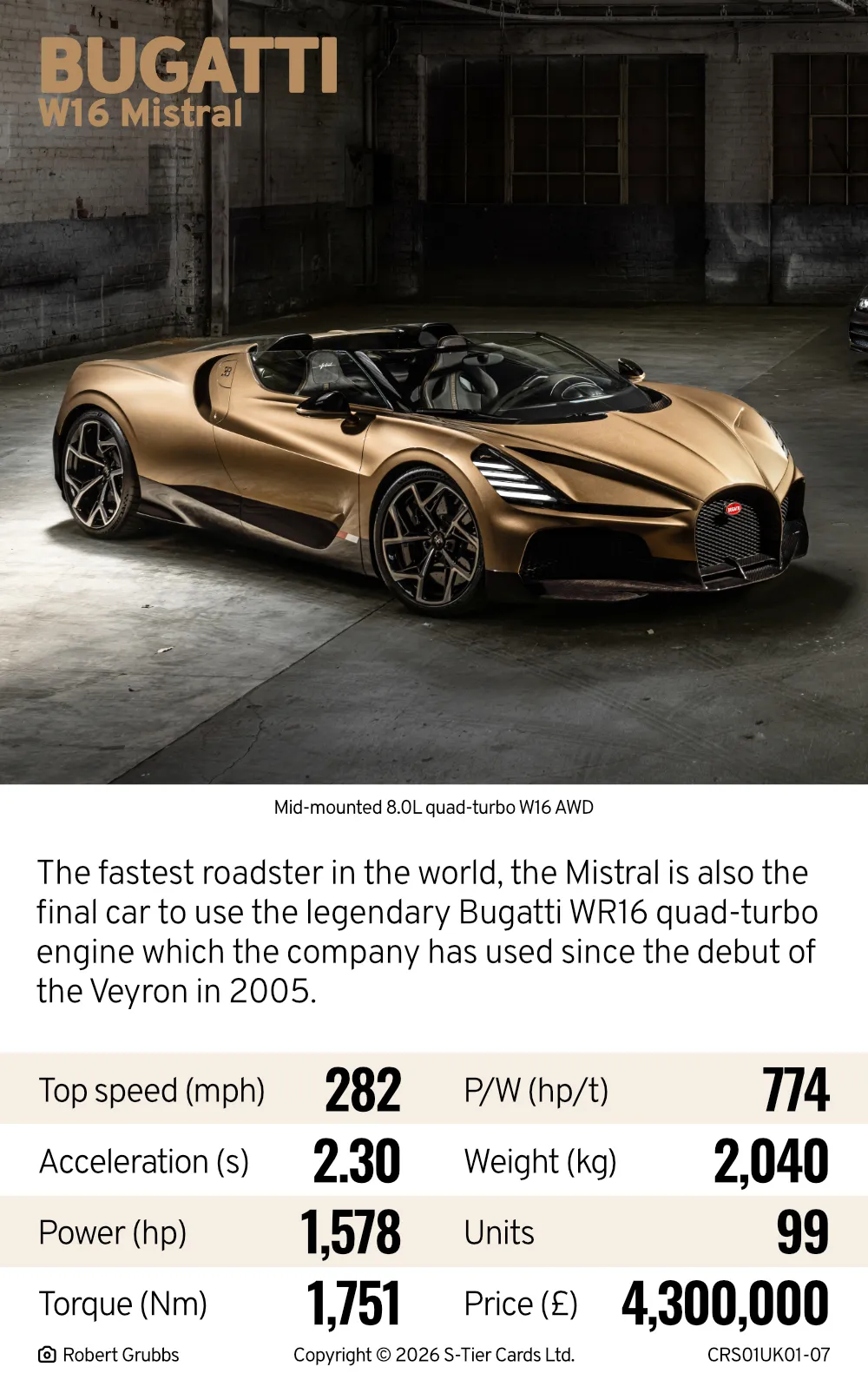
- Bugatti W16: The legendary quad-turbo W16 producing over 1,500 HP
- Hybrid Hypercars: Combining combustion and electric power for stratospheric outputs
- Electric Monsters: Pure EV hypercars redefining what’s possible with electric motors
The Complete Picture
When comparing power figures in Tier Cards, remember that:
- More power generally means higher top speed
- Power-to-weight ratio matters more than raw power for acceleration
- How power is delivered (torque curve) affects the driving experience
- The most powerful car isn’t always the fastest or most engaging
Power is one piece of a complex puzzle that makes a truly exceptional hypercar.