Weight: The Performance Multiplier
Colin Chapman, founder of Lotus, famously said: “Adding power makes you faster on the straights. Subtracting weight makes you faster everywhere.” In hypercars, weight is one of the most critical performance factors.
Why Weight Matters
Weight affects every aspect of a car’s performance:
Acceleration
Newton’s Second Law: Force = Mass × Acceleration. For a given amount of power, a lighter car will accelerate faster. This is why power-to-weight ratio (HP per tonne) is so important.
Braking
A heavier car requires more force to slow down. Weight is the enemy of braking performance — it increases stopping distances and puts more stress on brake components.
Cornering
Lighter cars change direction more easily and put less stress on tyres. Weight transfer during cornering affects grip and handling balance.
Efficiency
Moving mass requires energy. Lighter cars are more efficient, whether powered by combustion or electricity.
The Engineering Challenge
Reducing weight in a hypercar is extraordinarily difficult:
Structural Integrity
The car must be immensely strong to protect occupants and handle the forces generated by 1,000+ HP and 200+ mph speeds.
Safety Requirements
Modern safety regulations mandate crash structures, airbags and protective systems — all of which add weight.
Luxury Expectations
Hypercar buyers expect premium materials, sound insulation, climate control and infotainment — again, weight.
Cooling Systems
Powerful engines and brakes generate enormous heat. Adequate cooling requires radiators, ducting and fluid — more weight.
Lightweight Materials
Hypercar manufacturers use exotic materials to save weight:
Carbon Fibre
The wonder material of modern hypercars:
- Extremely strong relative to weight
- Can be moulded into complex shapes
- Used for chassis tubs, body panels and interior components
- Expensive and time-consuming to produce
Aluminium
Lighter than steel, strong enough for many applications:
- Suspension components
- Subframes
- Body panels
- Engine blocks
Titanium
Incredibly strong, lightweight, expensive:
- Exhaust systems
- Suspension bolts and fasteners
- Engine components like connecting rods and valves
Magnesium
Very light but prone to corrosion:
- Wheel centres
- Gearbox casings
- Structural components
Weight Distribution
It’s not just total weight that matters — where that weight sits is critical:
50/50 Balance
Ideal weight distribution (equal front and rear) provides neutral handling. Mid-engine layouts help achieve this.
Low Centre of Gravity
Keeping weight low improves handling and reduces body roll in corners. This is why batteries in electric cars are mounted in the floor.
Unsprung Weight
Weight of wheels, tyres, brakes and suspension components. Reducing unsprung weight improves ride quality and handling response.
Weight Classes in Hypercars
Different approaches to the weight challenge:
Lightweight Champions
Cars like the McLaren F1 (1,140 kg) prioritised weight reduction above all else. Modern equivalents like the Gordon Murray T.50 continue this philosophy.
The Heavy Hitters
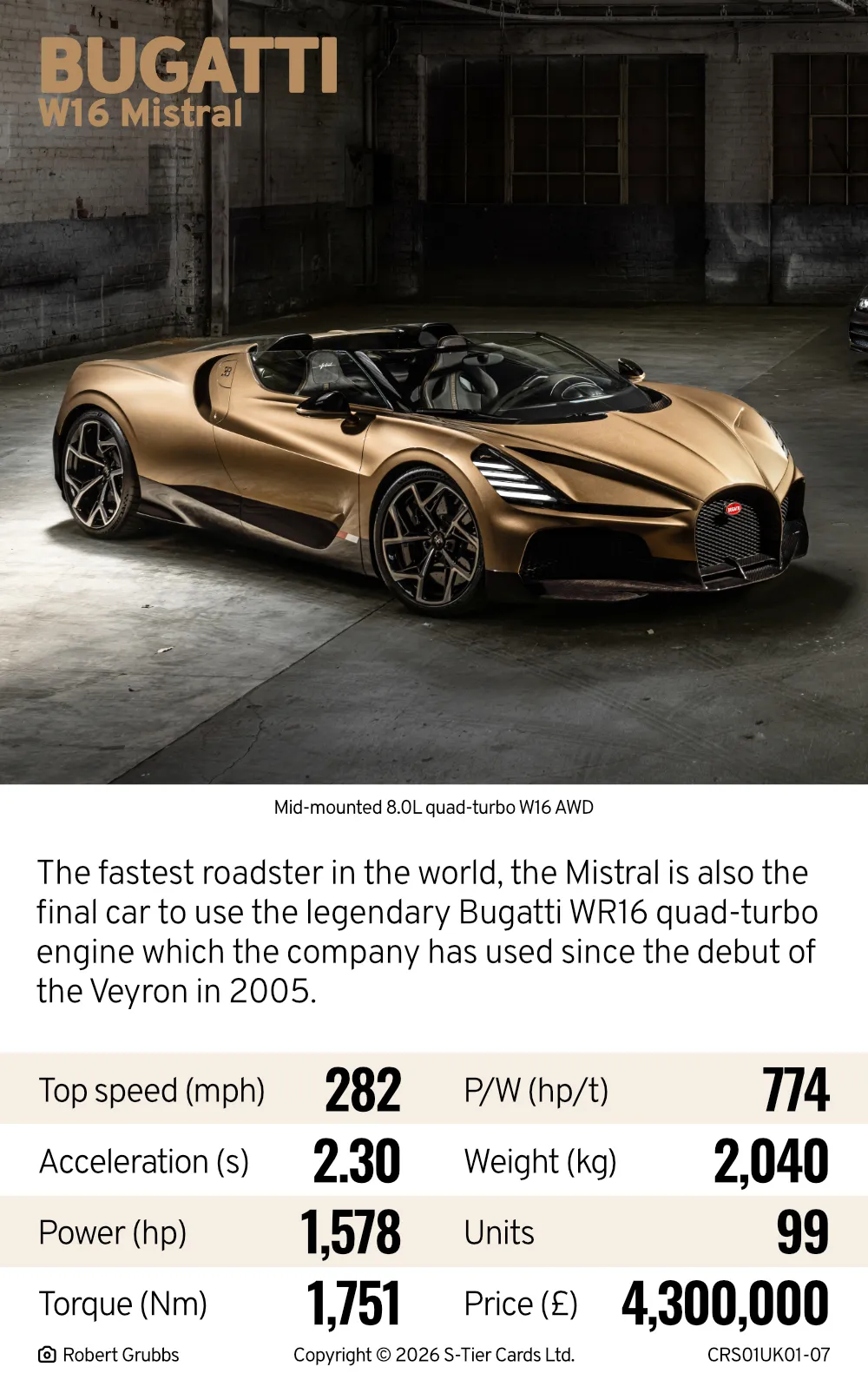
Bugatti’s Veyron and Chiron weigh around 2,000 kg — heavy by supercar standards but necessary to house the massive W16 engine, cooling systems and luxury features.
Electric Challenges
Battery weight is the Achilles heel of electric hypercars. The Rimac Nevera weighs 2,150 kg despite extensive use of carbon fibre — the battery pack alone weighs over 650 kg.
Hybrid Compromise
Hybrid hypercars carry both an engine and batteries, making weight management even more challenging. The SF90 Stradale weighs 1,570 kg dry — impressive given its hybrid complexity.
Power-to-Weight Ratio
The ultimate performance metric combines power and weight:
The Calculation
Power-to-weight is typically expressed as HP per tonne:
- 500 HP ÷ 1,000 kg = 500 HP/tonne
- 1,000 HP ÷ 2,000 kg = 500 HP/tonne (same ratio despite double the power)
What It Means
Higher power-to-weight ratios generally mean:
- Faster acceleration
- Better throttle response
- More engaging driving dynamics
- Often, higher top speed (though aerodynamics also plays a role)
Reference Points
- Sports car: 200-300 HP/tonne
- Supercar: 300-500 HP/tonne
- Hypercar: 500-1,000+ HP/tonne
The Weight Penalty
Adding weight has cascading effects:
The Spiral
More weight requires:
- Larger brakes (which add more weight)
- Stiffer suspension (which adds weight)
- Stronger chassis (more weight)
- More powerful engine (weight again)
The Solution
Start with a lightweight foundation. It’s far easier to keep weight out than to add lightness later.
Reading the Figures
When comparing weight in Tier Cards:
- Dry weight: Without fluids (oil, fuel, coolant) — lightest possible figure
- Kerb weight: With all fluids, ready to drive — more realistic
- Consider the power-to-weight ratio alongside absolute weight
- Remember that distribution matters as much as total mass
Weight is the invisible performance factor that affects everything else.